Wenzhou Zungwan - Packaging Machinery Equipment Manufacturers

- All
- Product Name
- Product Keyword
- Product Model
- Product Summary
- Product Description
- Multi Field Search



| Quantity: | |
|---|---|


ZHCJ-1926W
ZUNGWAN
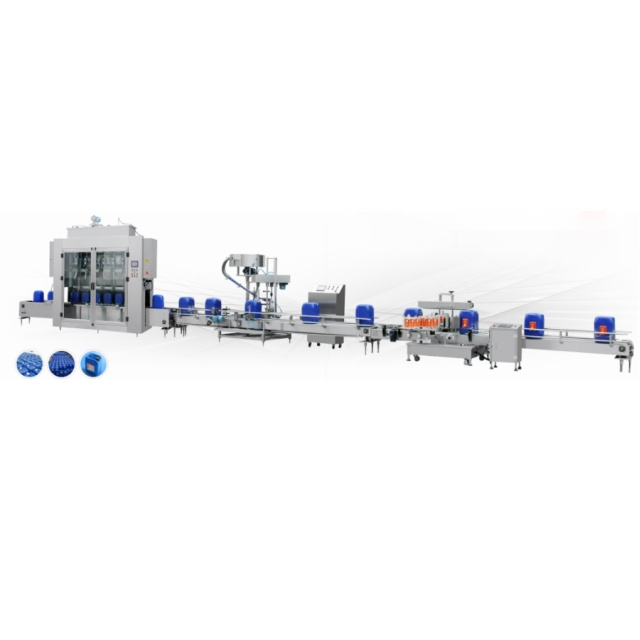
The ZHCJ-1926W is a six-head automatic weighing filling machine developed for dispensing liquid products into 10–25L containers. It combines container conveying, tare weighing, fast and slow filling, weight feedback, and filled-container discharge in one automated process.
Each filling station uses an independent weighing and feedback system. The target fill can therefore be set and adjusted according to the product, container, and required net weight.
The machine is suitable for water, coolant, lubricating oil, selected fine chemicals, pesticides, and other compatible industrial liquids. A diving filling mechanism helps control splashing and foam by lowering the filling nozzles toward or into the container during the filling cycle.
The published production capacity is up to 600 containers per hour, with a stated filling error of 0.2%. Actual performance depends on the fill quantity, liquid viscosity, density, foaming characteristics, supply pressure, container stability, and required accuracy.
Unlike a time-based or fixed-volume filling system, the ZHCJ-1926W measures the weight delivered into each container.
The basic process is:
An empty container enters the filling station.
The weighing platform detects the container.
The control system records or compensates for the tare weight.
The filling valve begins the fast-filling stage.
Flow decreases as the measured weight approaches the target.
Filling stops when the configured target is reached.
The filled container leaves the station.
Because the product is measured by weight, changes in temperature or density affect the relationship between weight and volume. The target should therefore be defined as net weight when weighing accuracy is the primary requirement.
The machine is equipped with six filling heads. Each head has an independent weighing and feedback system that can be adjusted separately.
Individual adjustment helps compensate for differences in:
Filling-valve response
Product flow
Supply-pipe length
Container position
Load-cell calibration
Mechanical installation
During commissioning, every weighing station should be calibrated using certified test weights and verified with the actual product.
The original product information lists an error range of 0.2%.
Before using this value as a contractual filling-accuracy guarantee, confirm whether it means:
±0.2% of the target net weight
A total range of 0.2%
Repeatability between consecutive containers
Accuracy after statistical averaging
Accuracy under specified product and speed conditions
The test liquid, target weight, container type, production speed, and measurement method should be stated in the technical agreement.
Containers enter the filling area through the conveyor. Sensors detect their arrival and coordinate the filling sequence through the PLC control system.
The infeed should maintain sufficient spacing so that each container reaches the correct weighing station without collision or misalignment.
The control system counts incoming containers and positions them beneath the filling heads. Correct positioning is particularly important for wide-mouth containers because an off-center nozzle can cause splashing or contaminate the container rim.
Guides should be adjusted to the actual container width and shape while allowing the container to move without excessive friction.
Container tare weight can vary because of manufacturing tolerances. A tare-weighing stage helps the system calculate the product’s net weight rather than treating all empty containers as identical.
The permitted container-weight variation should be evaluated during sample testing.
After filling, the containers move out of the weighing station for manual handling or integration with downstream equipment.
Depending on the packaging format, downstream equipment may include:
Cap or lid placing
Capping or lid pressing
Induction sealing
Leak inspection
Labeling
Inkjet coding
Checkweighing
Case packing
Palletizing
These functions are not included unless specified in the final line configuration.
The ZHCJ-1926W uses fast and slow filling stages.
Fast filling supplies most of the target quantity to maintain production efficiency. As the measured weight approaches the set point, the machine changes to slow filling to reduce overshoot and improve final weight control.
The changeover point should be configured according to:
Target weight
Liquid viscosity
Liquid density
Supply pressure
Valve response
Foaming behavior
Required accuracy
The filling nozzles move downward toward or into the container during filling. This shortens the free-fall distance and can help reduce splashing and foam.
The nozzle can rise according to the filling sequence where supported by the final machine configuration.
Diving filling is useful for products such as:
Foaming cleaning liquids
Coolant
Selected agricultural chemicals
Lubricating oils
Liquids that splash when discharged from height
The actual nozzle movement, immersion depth, and lifting program should be tested with the customer’s product and container.
Some oils and chemical liquids may drip or form strings after the valve closes. Appropriate nozzle design, cut-off control, suck-back, collection trays, or other options may be required depending on the material.
Drip-free performance should be evaluated using the actual product rather than water alone.
The machine is designed for large containers within the stated dimensional range.
Container Parameter | Published Requirement |
|---|---|
Filling Range | 10–25L |
Maximum Container Length | 350mm |
Maximum Container Width | 280mm |
Container Opening | At least Ø50mm |
Container compatibility also depends on:
Container height
Neck position
Opening position
Handle position
Bottom rigidity
Empty-container weight
Wall strength
Stability on the conveyor
Cap or lid format
Rectangular jerry cans, round pails, drums, and irregular containers may require different guide rails, positioning devices, or nozzle locations.
Customers should provide drawings and physical container samples before final machine production.
Weight-based filling can be used for lubricating oils packaged in large containers. The filling valve, pipe diameter, supply system, and nozzle should be selected according to viscosity and temperature.
The machine can fill compatible coolant products when the wetted materials, seals, and pipe components are chemically suitable.
Foaming behavior should be tested to determine the fast-to-slow filling transition and nozzle movement.
Water and compatible water-based products can be processed using the weighing system. High-flow applications require sufficient material supply and balanced pressure across all six heads.
Selected fine chemicals can be filled when their corrosiveness, toxicity, volatility, flammability, and material compatibility have been reviewed.
A standard machine should not be assumed to be suitable for hazardous chemicals without an application-specific safety assessment.
The page lists pesticide liquids as an application. Filling agricultural chemicals may require:
Corrosion-resistant contact components
Compatible seals and hoses
Enclosed filling areas
Exhaust or vapor collection
Spill containment
Operator protection
Dedicated cleaning procedures
Applicable electrical protection
The product Safety Data Sheet should be submitted before confirming the machine configuration.
Stable filling requires a suitable product-delivery system upstream of the machine.
The supply arrangement may include:
Storage tank
Buffer tank
Transfer pump
Level control
Filter
Pressure regulation
Return pipe
Temperature control
Agitation
Supply pressure should remain stable while multiple filling heads are operating. Insufficient supply can cause longer filling times or different flow behavior between heads.
The customer should provide product viscosity, density, operating temperature, and available supply pressure before the delivery system is selected.
The ZHCJ-1926W uses PLC-based control for coordinating container handling, weighing, and filling.
Depending on the final configuration, operators may be able to set or review:
Target net weight
Fast-filling quantity
Slow-filling quantity
Filling speed
Nozzle movement
Container count
Production status
Alarm information
Manual operation
Calibration settings
Recipe storage, password levels, data export, language selection, and remote communication should be confirmed as options rather than assumed standard functions.
Production parameters should only be changed by authorized operators.
The product page describes quick-connect filling pipes that can be disassembled for cleaning and maintenance.
Before changing products, operators should:
Stop the material supply.
Depressurize the filling circuit.
Drain the remaining product safely.
Remove the applicable pipes and nozzles.
Clean them using a compatible method.
Inspect seals and connections.
Reassemble the product path.
Run a controlled test before production.
The required cleaning method depends on whether the next product is compatible with the previous one.
Cross-contamination requirements should be defined for:
Different lubricant grades
Coolant formulations
Pesticides
Fine chemicals
Food-related liquids
Products with different colors or odors
The current page does not state that the machine has an automatic CIP system. Manual or semi-automatic cleaning requirements should therefore be confirmed.
The weighing platforms and load cells should be protected from impact, overload, accumulated product, and incorrect mechanical adjustment.
Routine checks should include:
Zero-point stability
Calibration accuracy
Platform movement
Cable condition
Sensor mounting
Conveyor alignment
Product buildup
Filling-valve response
The ZHCJ-1926W can operate as a standalone filling machine or form part of a larger packaging line.
A complete line may include:
Empty-container loading
Container conveying
Automatic weighing and filling
Cap or lid feeding
Capping or lid pressing
Sealing
Labeling
Coding
Weight inspection
Case packing or palletizing
Line integration should define the conveyor height, operating direction, container spacing, speed signals, alarm interlocks, and upstream/downstream control logic.
The published filling capacity does not automatically represent the output of a complete line. The slowest connected machine determines overall production speed.
Before confirming the ZHCJ-1926W, provide:
Product name
Safety Data Sheet
Density
Viscosity
Filling temperature
Foaming tendency
Target net weight
Permitted filling tolerance
Container dimensions
Container opening
Container sample
Required output
Available electrical supply
Available compressed air
Upstream supply method
Downstream packaging process
Cleaning requirements
Sample testing with the actual liquid and containers is recommended when accuracy, foam, chemical compatibility, or drip control is critical.
Parameter | Specification |
|---|---|
Model | ZHCJ-1926W |
Machine Type | Automatic weighing filling machine |
Number of Filling Heads | 6 |
Filling Range | 10–25L |
Published Capacity | Up to 600 containers/hour |
Published Filling Error | 0.2%; confirm definition and test conditions |
Maximum Container Size | L350 × W280mm |
Minimum Container Opening | Ø50mm |
Main Machine Dimensions | 2700 × 1900 × 2500mm |
Power Supply | 220V, 50Hz |
Main Machine Power | 3.5kW |
Compressed-Air Supply | 0.6–0.8MPa |
Control Method | PLC control |
Filling Method | Weight-based fast and slow diving filling |
Feedback | Independent weighing feedback for each head |
Pipe Connection | Quick-connect design |
Construction | Stainless-steel structure; grade to be confirmed |
Dimensions, capacity, power consumption, and accuracy should be reconfirmed after the machine configuration is finalized.
The installation site should provide:
Level and load-bearing floor
Required electrical supply
Stable compressed air
Product supply connection
Safe drainage or spill containment
Maintenance clearance
Adequate lighting
Suitable ventilation
Emergency access
Protection appropriate to the filled material
The machine must be leveled before the weighing systems are calibrated. Floor vibration and nearby equipment can affect weight readings.

ZUNGWAN supplies filling and packaging equipment for liquid, semi-liquid, cream, powder, food, cosmetic, pharmaceutical, daily chemical, and industrial applications.
Support for the ZHCJ-1926W can include:
Product and container evaluation
Filling tests
Machine configuration
Contact-material selection
Container-guide design
Production-line integration
Installation guidance
Operator training
Parameter setup
Spare-parts planning
Technical troubleshooting
Customers can submit product samples, containers, caps, labels, drawings, and production requirements for project evaluation.
It is a weight-based filling machine. Each filling station measures the amount delivered into the container using an independent weighing and feedback system.
The published filling range is 10–25L. Container length, width, height, opening position, stability, and empty weight must also match the machine configuration.
The page lists a 0.2% filling error, but the exact definition and testing conditions should be confirmed. Accuracy depends on the product, target weight, filling speed, container, and calibration.
The published capacity is up to 600 containers per hour. Actual output depends on fill quantity, product flow, viscosity, foam, container handling, and downstream equipment.
Yes. Each of the six filling heads has an independent weighing and feedback system that can be calibrated or fine-tuned separately.
The diving nozzle and fast/slow filling sequence can help reduce foam. Final performance should be tested using the actual product.
Yes. The page lists lubricating oil as an application. Product viscosity, temperature, pipe diameter, valve type, seals, and supply pressure should be reviewed.
It may fill compatible chemical and pesticide liquids after their Safety Data Sheets, corrosiveness, flammability, toxicity, seals, contact materials, and ventilation requirements have been assessed.
The current configuration is described as a filling machine. Capping, sealing, labeling, coding, and case packing should be ordered as separate or integrated line equipment.
The filling pipes use quick connections to support disassembly and cleaning. The required cleaning process depends on the product and cross-contamination requirements.
Provide representative liquid, empty containers, caps or lids, container drawings, target weight, required speed, filling tolerance, and the product Safety Data Sheet.
The listed supply is 220V, 50Hz with 3.5kW main-machine power and compressed air at 0.6–0.8MPa. Electrical phase, air consumption, and site connections should be confirmed before installation.
Filling Process Configuration
Send us your liquid properties, target net weight, container dimensions, required output, and filling tolerance. Our engineers will review the application and recommend a suitable ZHCJ-1926W filling configuration.


