Wenzhou Zungwan - Packaging Machinery Equipment Manufacturers

- All
- Product Name
- Product Keyword
- Product Model
- Product Summary
- Product Description
- Multi Field Search



loading
| Availability: | |
|---|---|
| Quantity: | |


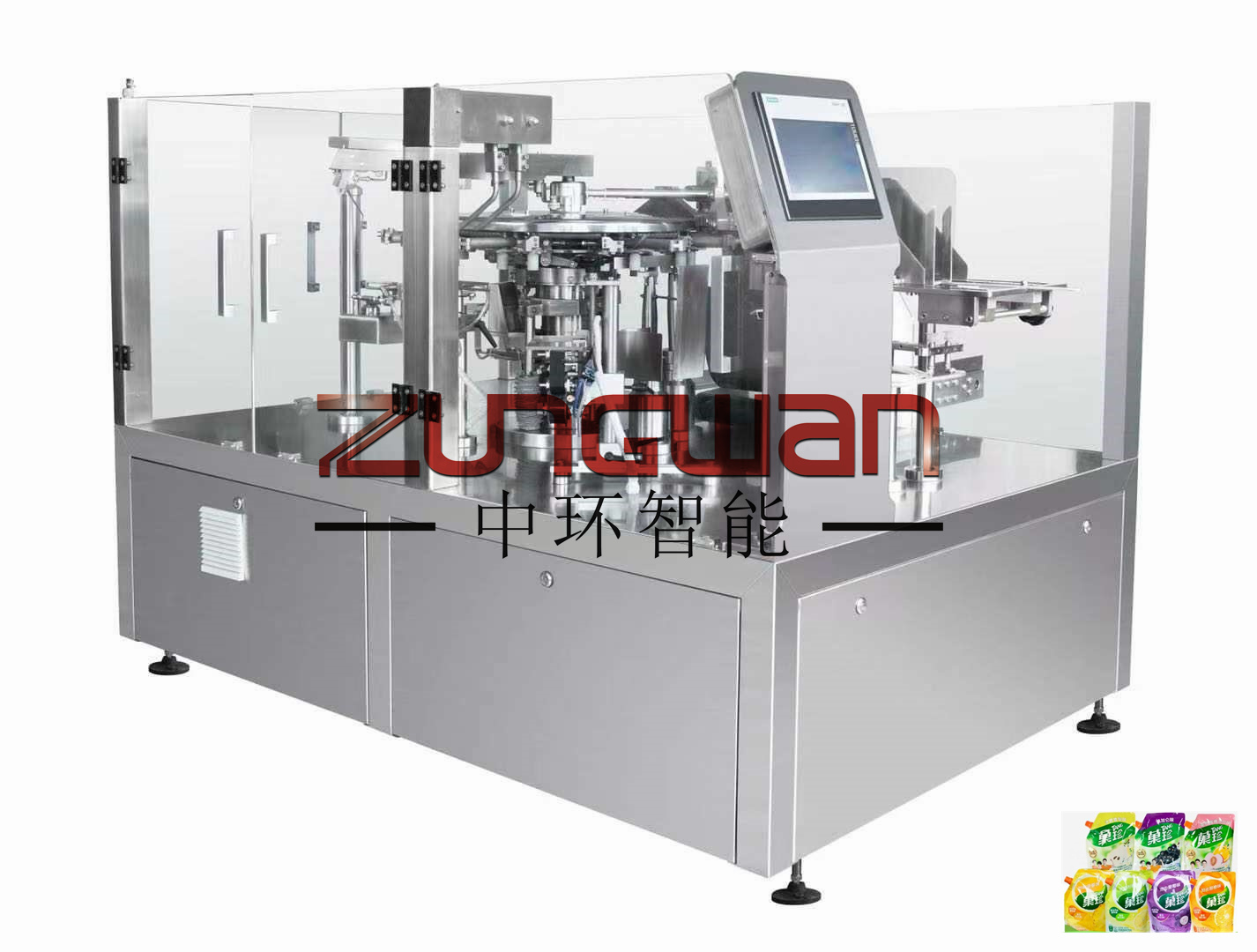
MSZP8-200
ZUNGWAN
The MSZP8-200 Automatic Rotary Premade Pouch Packing Machine is designed to feed, open, fill, and seal compatible preformed pouches through a six- or eight-station rotary process.
It handles pouches from 90 to 200 mm wide and 100 to 350 mm long. Supported formats include stand-up pouches, flat pouches, zipper pouches, handle pouches, and compatible three-side- or four-side-seal bags.
The rotary pouch-handling platform can be matched with different dosing systems for liquids, sauces, powders, granules, snacks, and irregular solid products. The correct filling equipment must be selected according to the product’s flow characteristics, target weight, required accuracy, and cleaning requirements.
Empty premade pouches are loaded into the bag magazine. The pouch-feeding mechanism transfers individual bags to the rotary grippers.
Bag thickness, surface friction, zipper position, and dimensional consistency affect feeding performance. Final production pouches should be tested before the bag magazine and gripping system are approved.
The rotary grippers hold each pouch as it moves through the configured operating stations.
Gripper width must be adjusted when pouch dimensions change. The pouch should remain stable without being stretched, creased, or damaged.
The pouch-opening station separates the front and rear panels before filling. Opening performance depends on pouch flatness, film stiffness, static electricity, zipper structure, and the condition of the pouch mouth.
An unopened pouch should not proceed to filling. The availability of bag-opening detection and no-open-no-fill control should be confirmed in the ordered configuration.
The opened pouch moves to the filling station, where the selected dosing system dispenses the product.
The MSZP8-200 is the pouch-handling and sealing platform. Liquid, powder, granule, and solid products require different feeding and metering equipment.
Depending on the product, an additional station may be used for product settling, air removal, vibration, or cleaning material away from the sealing area.
Powder, sauce, oil, or product particles left on the pouch mouth can reduce seal consistency.
The filled pouch enters the sealing station. Sealing temperature, pressure, and dwell time must be matched to the pouch material and production speed.
A second sealing or cooling station may be configured where the pouch structure or application requires it.
Sealed pouches are released from the rotary machine for inspection, metal detection, checkweighing, cartoning, case packing, or collection.
The MSZP8-200 can package different product categories when equipped with the appropriate dosing system. One filling system should not be assumed to handle every material.
Free-flowing liquids may require a pump, flowmeter, gravity, or other liquid-metering system selected according to:
Product viscosity
Filling volume
Required accuracy
Foaming tendency
Product temperature
Chemical compatibility
Cleaning method
Production speed
Typical applications may include soy sauce, vinegar, juice, rice wine, liquid detergent, peanut milk, and compatible hand-sanitizer products.
Liquids containing alcohol, solvents, corrosive ingredients, or suspended solids require a separate compatibility assessment.
Ketchup, jam, chili sauce, bean paste, seasoning sauce, peanut butter, and hot-pot base materials may require a piston or other positive-displacement filling system.
Sauce packaging should be evaluated for:
Viscosity
Product particles
Filling temperature
Oil separation
Required hopper capacity
Agitation requirements
Heating requirements
Nozzle diameter
Cleaning access
Products containing large particles require a filling path that can pass the particles without crushing or blocking them.
Powders such as coffee, milk powder, salt, seasoning powder, monosodium glutamate, and powdered drink mixes may be handled using a compatible auger or other powder-dosing system.
Powder behavior varies according to:
Bulk density
Flowability
Dust level
Moisture sensitivity
Particle size
Electrostatic behavior
Required weight accuracy
Dust extraction or pouch-mouth cleaning may be required to keep powder away from the heat-seal area.
Granules, nuts, seeds, candy, chocolate, dried fruit, chips, biscuits, and other solid products may require a volumetric cup, linear weigher, multihead weigher, counting system, or application-specific feeder.
Fragile products should be evaluated for drop height and handling impact. Irregular products should be tested to confirm that they enter the pouch without bridging or damaging the bag mouth.
The published pouch range is:
Width: 90–200 mm
Length: 100–350 mm
Both dimensions must be considered together. A pouch within the stated width may still require evaluation if its length, gusset, zipper, handle, or opening structure differs from the standard configuration.
The MSZP8-200 may handle compatible:
Stand-up pouches
Flat pouches
Three-side-seal pouches
Four-side-seal pouches
Zipper pouches
Handle pouches
Spouted pouches, unusually shaped bags, quad-seal bags, retort pouches, and pouches with special fitments require separate confirmation.
The original specifications reference composite film, PE, and PP pouch materials.
Successful heat sealing depends on the complete film structure rather than the outer material name alone. Customers should provide:
Film-layer structure
Total thickness
Heat-seal layer
Recommended sealing temperature
Pouch supplier specifications
Final production samples
Zipper pouches require the mouth to be opened without damaging the zipper. Depending on the pouch design, a zipper-opening or zipper-closing mechanism may be needed.
The zipper position should remain consistent across the supplied pouch batch.
Filling accuracy is determined mainly by the selected dosing system, product characteristics, target weight, and operating speed.
The original page does not publish an accuracy value. Customers should define the permitted tolerance before the filling system is selected.
The seal area should remain free from product contamination. Sauce, oil, powder, crumbs, or sharp particles between the film layers can affect seal strength or appearance.
Depending on the product, the machine may require:
Anti-drip filling nozzles
Pouch-mouth spreading
Dust extraction
Seal-area cleaning
Product settling
Vibration
Air removal
Controlled filling height
Sealing temperature, pressure, alignment, and dwell time should be established through pouch testing.
Too little heat or pressure may create an incomplete seal. Excessive heat may deform the film, damage the zipper, or affect pouch appearance.
Production checks should include:
Seal appearance
Seal width
Wrinkles and folds
Product contamination
Leakage
Burst or peel testing where required
Date-code position
Net-weight verification
The required inspection method depends on the product and applicable packaging standard.
The MSZP8-200 is available with six or eight mechanical stations. The final station arrangement depends on the product and pouch process.
A configured sequence may include:
Pouch feeding
Pouch gripping
Coding or opening
Pouch opening and detection
Product filling
Product settling or secondary filling
Heat sealing
Cooling and discharge
The actual station allocation should be shown in the final machine drawing. An eight-station configuration may provide more space for secondary filling, settling, cleaning, sealing, or inspection functions.
The published maximum speed is up to 60 bags per minute.
Actual output depends on:
Product type
Target filling weight
Dosing-system speed
Pouch dimensions
Pouch quality
Zipper or closure structure
Number of operating stations
Filling accuracy
Sealing dwell time
Product settling requirements
Upstream product supply
The maximum mechanical speed should not be treated as guaranteed production output for every product.
Sauces, difficult powders, fragile snacks, large fill weights, or products requiring long settling times may operate below the published maximum.
The machine may be configured for compatible liquids such as:
Soy sauce
Rice vinegar
Rice wine
Fruit juice
Liquid detergent
Peanut milk
Hand sanitizer
Other free-flowing liquids
The selected pouch, sealing layer, pump, gasket, and hose materials must be compatible with the formula.
Compatible sauce applications include:
Ketchup
Chili sauce
Bean paste
Jam
Peanut butter
Seasoning sauce
Hot-pot base material
Oil-and-solid mixtures
Particle size, viscosity, filling temperature, and oil content should be supplied before the dosing system is selected.
Powder applications may include:
Coffee powder
Milk powder
Salt
Seasoning powder
Monosodium glutamate
Chicken seasoning
Powdered drink mixes
Other free-flowing powders
Dusty, sticky, aerated, or moisture-sensitive powders require application-specific testing.
Compatible granule and solid products may include:
Nuts
Peanuts
Seeds
Candy
Chocolate
Dried fruit
Biscuits
Potato chips
Other snack products
Fragile products should be tested for breakage during feeding, weighing, filling, and discharge.
The machine may also be evaluated for compatible detergent, household, chemical, and daily-use products.
Food and non-food products should not share the same contact components without a suitable cleaning, segregation, and cross-contamination plan.
Changing to a different pouch may require adjustment of:
Bag magazine
Pouch-feeding guides
Rotary grippers
Opening suction cups
Filling-funnel position
Sealing-jaw position
Coding position
Discharge settings
Changeover time depends on pouch similarity, operator experience, and the number of parts that must be replaced.
Changing between liquids, sauces, powders, or solid products may require replacement of the complete dosing and feeding system rather than a simple parameter adjustment.
Customers planning to run several products should define:
Changeover frequency
Cleaning method
Allergen controls
Cross-contamination limits
Tool-free component requirements
Washdown requirements
Product-recovery procedures
Product-contact components should be accessible for inspection and cleaning. The required design depends on whether the machine handles food, detergent, chemical, or other products.
The stainless-steel grade, surface finish, food-contact documents, and washdown rating should be confirmed for the final configuration.
The MSZP8-200 may be connected with appropriate upstream and downstream equipment.
Possible equipment includes:
Liquid holding tank
Sauce hopper with agitation
Powder screw conveyor
Vacuum powder feeder
Auger filler
Volumetric cup filler
Linear weigher
Multihead weigher
Z-type bucket elevator
Product conveyor
Date coder
Checkweigher
Metal detector
Seal inspection
Finished-pouch conveyor
Cartoning machine
Case packing equipment
Control signals, production speed, equipment height, product accumulation, and fault handling should be coordinated during line design.
Provide the following information for technical evaluation:
Product name and description
Product samples
Bulk density or viscosity
Maximum particle size
Filling temperature
Target filling weight or volume
Permitted filling tolerance
Pouch width and length
Pouch material and thickness
Pouch format and zipper details
Required production speed
Available electrical supply
Available compressed-air pressure and flow
Cleaning requirements
Required coding and inspection functions
Upstream and downstream equipment
Final production pouches and representative product samples are recommended for machine testing.
Parameter | Specification |
|---|---|
Model | MSZP8-200 |
Machine Type | Automatic rotary premade pouch packing machine |
Mechanical Stations | Six or eight stations |
Pouch Width | 90–200 mm |
Pouch Length | 100–350 mm |
Pouch Formats | Stand-up, flat, three-side-seal, four-side-seal, zipper and compatible handle pouches |
Pouch Materials | Composite film, PE, PP and compatible heat-sealable structures |
Maximum Published Speed | Up to 60 bags/min |
Dosing System | Selected according to liquid, sauce, powder, granule or solid product |
Power Supply | Three-phase 380V, 50/60Hz |
Total Power | 4 kW |
Compressed-Air Consumption | 0.6 m³/min, supplied by the customer |
Compressed-Air Pressure | To be confirmed |
Machine Weight | Approximately 1,100 kg |
Filling Accuracy | Depends on the selected dosing system |
Control System | To be confirmed |
Machine Dimensions | To be confirmed |
Product-Contact Material | To be confirmed according to the application |
Actual specifications and output depend on the pouch, product, dosing system, station arrangement, and ordered options.
ZUNGWAN can review the product, pouch, target weight, and production requirements before preparing the MSZP8-200 configuration.
Project support may include:
Product and pouch evaluation
Dosing-system selection
Rotary-station arrangement
Pouch-feeding tests
Filling trials
Heat-seal testing
Production-line layout
Upstream and downstream integration
Installation guidance
Operator training
Spare-parts planning
Customers should request a final technical agreement, approved pouch samples, machine layout, station diagram, utility list, and test criteria before ordering.
No. It is a rotary premade pouch handling and sealing platform. By matching the appropriate dosing system, it can package compatible liquids, sauces, powders, granules, and solid products.
Normally, no. Sauces and powders have different flow and metering characteristics. A sauce pump and a powder auger filler are separate systems.
The published range is 90–200 mm wide and 100–350 mm long. Gussets, zippers, handles, film stiffness, and pouch shape must also be evaluated.
Compatible zipper pouches are listed as supported. The actual pouch must be tested because zipper position and opening force affect automatic handling.
The published maximum is up to 60 bags per minute. Actual speed depends on the product, fill weight, dosing system, pouch, and sealing requirements.
It may handle compatible sauces with particles and irregular solid products when the filling path and dosing system are sized correctly. Maximum particle size must be supplied for evaluation.
An auger filler or another powder-metering system may be used depending on bulk density, flowability, dust level, and required accuracy.
A volumetric cup, linear weigher, or multihead weigher may be selected according to product size, fragility, target weight, and accuracy.
Hot filling may be possible when the hopper, pump, hoses, seals, pouch material, and heat-sealing process are designed for the required temperature. The maximum product temperature must be confirmed.
No. This model is designed to handle premade pouches. A form-fill-seal machine is required when bags must be produced from rollstock during packaging.
Yes. The published air consumption is 0.6 m³/min. The required operating pressure should be confirmed in the technical specification.
Provide representative product samples and final production pouches. For several products or pouch formats, supply each intended combination for testing.
Configure Your Premade Pouch Line
Send us your product characteristics, target filling weight, pouch dimensions, film structure, and required output. Our team will review the application and recommend a suitable MSZP8-200 dosing, pouch-handling, and sealing configuration.
Final production pouches and representative product samples are recommended for configuration review and machine testing.


