Wenzhou Zungwan - Packaging Machinery Equipment Manufacturers

- All
- Product Name
- Product Keyword
- Product Model
- Product Summary
- Product Description
- Multi Field Search

Views: 0 Author: Site Editor Publish Time: 2026-11-20 Origin: Site
In high-volume oral care manufacturing, marginal deviations in fill weight compound into significant financial losses. Overfilling causes massive product giveaway. This practice directly destroys profit margins and inflates material costs. Conversely, underfilling triggers strict regulatory non-compliance. It severely damages consumer trust and invites sudden product recalls.
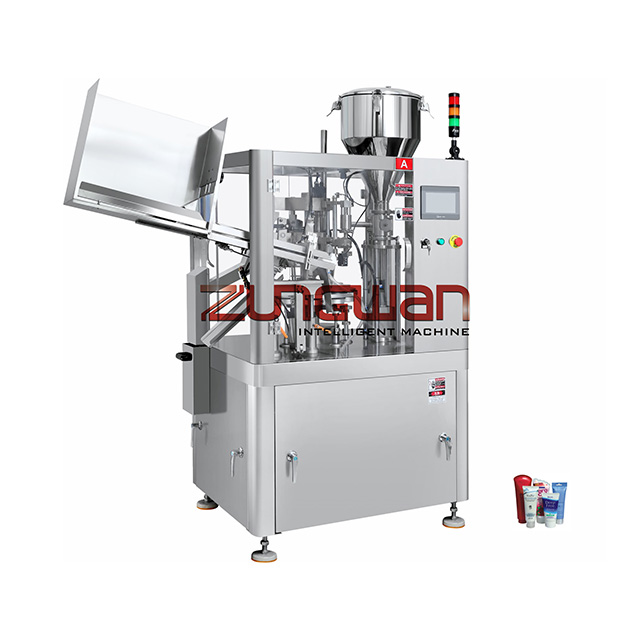
Toothpaste presents a uniquely difficult technical challenge on the production floor. It behaves as a highly viscous, non-Newtonian fluid. It also contains harsh abrasive agents that destroy moving parts. Maintaining precise dosing requires highly specialized mechanical handling. It demands robust process controls to handle changing fluid dynamics. Upgrading or optimizing your Tube Filling and Sealing Machine acts as your primary lever. It eliminates costly standard deviation in batch weights. When producing millions of units annually, every single gram matters. You will learn how to identify hidden root causes of weight drift. We will explore modern servo-driven technologies and environmental controls. Finally, you will discover how automated checkweighing systems lock in dosing precision.
Mechanical wear is a silent margin killer: The abrasive nature of toothpaste silica degrades dosing pumps, making regular maintenance and robust machine design critical.
Precision requires modern automation: Servo-driven dosing combined with positive displacement pumps provides the baseline for high toothpaste tube filling accuracy.
Control the environment to control the weight: Consistent hopper head pressure and product temperature are prerequisites for accurate volumetric filling.
Closed-loop systems drive consistency: True toothpaste filling line quality control relies on integrated checkweighing that automatically adjusts dosing parameters in real-time.
Let us examine the financial drain of inaccurate dosing. Overfilling causes massive product giveaway. Imagine a 1.5-gram overfill on a line running 120 tubes per minute. In one hour, you lose 10,800 grams. Over two shifts, this equals over 170 kilograms of wasted product daily. Annually, this hidden leak costs hundreds of thousands of dollars. Tightening the standard deviation fixes this. A narrow bell curve allows you to shift the target average downward. You can confidently target closer to the label claim without fear of underfilling.
Legal requirements dictate strict adherence to package claims. Agencies enforce Minimum Quantity (MQ) rules rigorously. The NIST handbook outlines precise average weight standards. GMP guidelines mandate consistent dosing documentation. Failing these standards invites audits. Regulators will issue fines or force product recalls. Brand damage from underweight products lingers for years.
Industry leaders measure Overall Equipment Effectiveness (OEE) strictly. We view tube filler weight variation as a direct quality loss. Rejecting tubes requires expensive rework. Often, you must scrap the packaging entirely. You lose both the formulated paste and the expensive plastic tube. This inefficiency ruins the overall ROI of your production line. Maximizing OEE requires eliminating these micro-stops and quality rejects entirely.
Toothpaste rheology constantly disrupts volumetric measurement. Temperature changes alter paste viscosity instantly. Warmer paste flows easily, while colder paste thickens. This shift changes how completely the dosing cylinder fills during the intake stroke. Furthermore, entrapped air creates hidden micro-voids. Mixers often trap air during the compounding phase. Volumetric pumps measure physical space, not mass. Pumping a pocket of air means the final tube receives less actual product.
Hopper head pressure dictates feed consistency. Gravity pushes paste down into the dosing pump. When the hopper runs nearly empty, gravitational pressure drops. The pump struggles to pull a full charge of thick paste. This causes immediate weight drift. You must keep hopper levels tightly controlled to maintain equilibrium.
Abrasive ingredients destroy machinery slowly. Toothpaste formulations rely on silica and calcium carbonate. These polishing agents act exactly like liquid sandpaper. They physically erode piston seals. They wear down O-rings and score metal rotary valves. Over millions of cycles, this wear creates tiny gaps. Micro-leaks occur during the high-pressure dispensing stroke. Product slips backward past the damaged seal. You lose volumetric precision permanently until parts are replaced.
Evaluating new equipment requires strict criteria. You must demand specific architectural features to guarantee consistency.
Servo-driven dosing technology outperforms legacy systems easily. Old machines rely on mechanical cam shafts. Cams offer fixed, rigid movements. Modern servo motors provide dynamic, programmable control. You can map the exact acceleration curve of the piston. You can slow the piston right before the stroke ends. This precise deceleration prevents messy stringing. It guarantees high toothpaste tube filling accuracy regardless of paste thickness.
Positive displacement rotary valve pumps serve as the gold standard. We specify this pump architecture for all abrasive pastes. Rotary valves shear cleanly through thick material. They capture a highly precise volume. They maintain a perfect seal without losing prime during long production runs.
Advanced nozzle design eliminates product dripping. You must specify positive shut-off nozzles. They incorporate internal mechanical pins that physically block the opening. Furthermore, integrate a suck-back mechanism. This feature pulls a slight vacuum at the end of the dose. It snaps the paste string instantly. Drips alter final tube weight and ruin cosmetic appeal. They also contaminate the sealing area. A contaminated seal inevitably bursts during retail transport.
Automated level control systems prevent pressure drops. Top-tier machines utilize non-contact ultrasonic or laser sensors. These sensors monitor the hopper paste level continuously. They command the bulk supply pump to refill the hopper automatically. They maintain the level within a strict one-inch tolerance. Constant head pressure guarantees constant fill weights.
Dosing Technology Comparison Chart
Feature | Mechanical Cam System | Servo-Driven System |
|---|---|---|
Stroke Control | Fixed mechanical path | Fully programmable profiles |
Adjustment Speed | Requires manual tool intervention | Instant digital HMI adjustment |
Anti-Stringing | Limited physical adjustments | Custom deceleration mapping |
Trend Control Integration | Impossible without retrofits | Native closed-loop capability |
Manual sampling fails to capture dynamic line conditions. Operators pulling five tubes every thirty minutes miss critical trends. Modern standards demand 100% automated in-line checkweighing. A high-speed checkweigher weighs every single tube immediately after sealing. It ejects out-of-spec tubes instantly without stopping the entire line.
Closed-loop feedback represents true process control. We call this trend control. Advanced PLCs gather continuous mass data from the checkweigher. They calculate a rolling average. If the weight begins drifting downwards due to temperature drops, the system reacts. The PLC sends a signal directly to the servo motor. It micro-adjusts the stroke length. This adjustment corrects the volume before any tubes violate the lower weight limit. This automated loop defines modern toothpaste filling line quality control.
Data traceability secures your compliance standing. Machine software automatically logs all batch weight data. It records every servo adjustment and every rejected tube. We rely on these digital logs for strict GMP compliance. Quality assurance teams use this data during regulatory audits. Furthermore, engineering teams analyze this historical data. They identify long-term wear trends and optimize machine settings.
High-precision equipment requires disciplined operation. You must balance extreme accuracy with changeover speed. Highly calibrated servo systems run perfectly during steady-state production. However, marketing demands frequent product changes. Switching from a standard paste to a dual-stripe gel introduces mechanical complexity. You must clean the rotary valves perfectly. You must recalibrate the checkweigher parameters. Rapid changeovers challenge your operational efficiency.
Strict preventive maintenance (PM) imperatives dictate success. Even the finest machines degrade without care. You must enforce rigid PM schedules. Abrasive silica will eventually defeat any seal material. Evaluate OEM support before purchasing. Look closely at the dosing station design. Technicians need open, ergonomic access. They must clean components and swap O-rings swiftly.
Operator dependency poses a massive adoption risk. We frequently see operators sabotage automated systems out of habit. An operator might manually tweak a setting, fighting the closed-loop feedback. You must train operators thoroughly on the HMI diagnostic screens. They need to trust the automated trend control.
Follow these operational best practices to minimize risks:
Establish clear PM intervals based on machine cycle counts, not calendar days.
Restrict manual override access using password-protected HMI security levels.
Calibrate hopper level sensors weekly to ensure accurate gravitational head pressure.
Perform viscosity checks on bulk paste before transferring it to the filling machine.
Validate the checkweigher tare weight dynamically at the start of every shift.
Eliminating weight deviation requires an integrated manufacturing strategy. You must combine capable hardware with highly intelligent software. Servo-driven positive displacement pumps physically handle the tough rheology of toothpaste. Closed-loop feedback systems intelligently monitor and correct the output dynamically. Together, they guarantee precision and protect your margins.
Take decisive action during the equipment selection phase. When drafting an RFP, demand strict performance guarantees. Ask the OEM to provide verifiable Cpk values. These metrics must reflect the specific abrasive profile of your paste. Test your proprietary formulas during the factory acceptance test. Never accept generic performance claims without empirical data.
A: Standard industry tolerances typically range from ±0.5% to ±1% of the target weight. This acceptable variation depends heavily on the tube volume and the machine speed. Smaller travel sizes often see slightly higher percentage variations compared to large family tubes. Maintaining these tight tolerances requires servo-driven dosing and consistent paste temperatures.
A: Air entrapment creates a critical difference between volumetric and mass filling. Most automatic tube fillers dispense a specific volume of paste. Entrapped air bubbles reduce the overall density of the mixture. Consequently, the same physical volume dispenses a noticeably lower actual mass. This leads to immediate underfills. Vacuum mixing prevents this issue.
A: Yes, you can often upgrade mechanical fillers. Facilities frequently retrofit older machines by adding automated hopper level controls or positive shut-off nozzles. However, replacing mechanical cam-driven pumps with fully integrated servo modules is highly complex. Often, replacing the entire unit provides better long-term reliability and tighter accuracy guarantees.